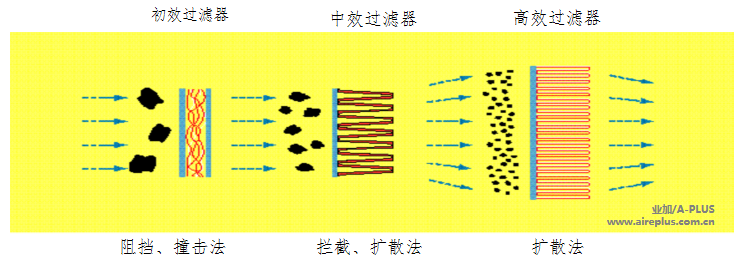


I. Blocking Principle:
Also known as the "sieve principle", when the particle diameter is larger than the gap between fibers, the particle is blocked. This method is commonly used in primary filters.
II. Impact Principle:
For larger particles, as the air flows through the air filter, the direction of the airflow changes repeatedly when passing through the fibers. Due to the effect of inertia, the air particles cannot adapt to this frequent and continuous change, and ultimately do not flow with the airflow but remain in the air filter. Some fibers increase the viscosity of the fibers to enhance the effect of this principle.
III. Interception Principle:
Interception is a special type of impact. Its particle size is similar to the fiber diameter. When the particle flows with the airflow, due to the effect of inertia and the "van der Waals force" between the particle and the fiber, it eventually remains in the air filter.
IV. Diffusion Principle:
For smaller particles, their flow direction and speed are easily affected by Brownian motion, thus unable to follow the airflow. The air particles move irregularly in the fiber filter paper and eventually remain in the filter paper. This principle is generally applied in high-efficiency filters.
The mechanism diagrams of various efficiency filters are as follows: